
Welcome to the Ohio Chamber's
Workplace Mental Health Resource

Mental health in the workplace is no longer a peripheral concern—it's a core business imperative that directly impacts your bottom line. The Ohio Chamber of Commerce Research Foundation has developed this toolkit to provide Ohio employers of all sizes with evidence-based strategies, practical implementation guides, and Ohio-specific resources to support employee mental well-being.
Whether you're a small business owner taking your first steps toward creating a supportive workplace, or a large organization looking to enhance existing programs, this toolkit provides a roadmap tailored to Ohio's unique workforce challenges and opportunities.
Designed for Ohio Employers of Every Size
From Wellness Perk to Business-Critical Priority
The corporate perspective on mental health has undergone a fundamental transformation. What was once viewed as a purely personal concern has become a business-critical priority that directly influences productivity, employee engagement, and organizational success.
"Supporting employee well-being is both a moral commitment and a crucial metric of business sustainability and organizational values."
This strategic shift is driven by hard financial realities: untreated mental health conditions cost U.S. businesses tens of billions of dollars annually in lost productivity alone. Ohio employers are moving beyond reactive measures, adopting structured, proactive strategies including Employee Assistance Programs (EAPs), leadership-led stigma reduction campaigns, and flexible work arrangements.
From Wellness Perk to Business-Critical Priority
ABSENTEEISM
- **Key Statistic (Large, Bold):** 62.2% of all "out of role" days
- **Key Statistic:** 7% of global payroll costs
- Depression alone: 31.4 missed workdays per affected employee annually
- Easily tracked in most HR systems
PRESENTEEISM (The Greater Threat)
- Definition: Reduced capacity while physically at work
- **Key Statistic (Large, Bold):** 81% of lost productivity time
- **Key Statistic:** 5.1x greater losses than absenteeism
- Depression impact: 35% reduction in productivity
- **Critical Insight Box:** "Most employers track sick days but have no metric for presenteeism—leaving them blind to their single largest source of productivity loss."
Winning the War for Talent
Keep Your Best People
Employees who feel valued and supported are significantly more likely to stay. National polls show substantial numbers of employees—particularly younger workers—have considered quitting due to negative mental health impacts.
Activate Your Investments
Stigma is the single greatest barrier to employees seeking treatment. When senior executives openly champion mental health, they create a culture of safety that maximizes ROI on existing programs like EAPs.
Barclays' "This is Me" Campaign
Leadership-driven mental health campaign that successfully reduced stigma and increased EAP utilization without additional program costs.
Creating a Culture Where Employees Can Thrive
Effective mental health support isn't just about providing resources—it's about creating an environment where employees feel safe enough to use them. This is psychological safety: a workplace culture where individuals can bring their whole selves to work, discuss challenges, and seek support without fear of discrimination or reprisal.

U.S. Surgeon General's Framework for Workplace Mental Health
Protection from Harm
- Physical safety
- Psychological safety
- Enabling adequate rest
- Normalizing mental health conversations
- Confidential access to care
Action Items for Employers:
- Train managers to recognize distress signs
- Set realistic workloads (70%+ report unrealistic expectations)
- Create inclusive dialogue spaces
- Ensure work-life balance policies
Addressing the Root Cause Many Employers Miss
Financial stress—anxieties about debt, savings, and daily expenses—is a significant but often-overlooked driver of poor mental health. Leading Ohio employers are integrating financial wellness programs as a form of preventive mental healthcare.
- Personalized financial assessments
- Individualized coaching addressing life stage challenges
- Fiduciary advisors (not product sellers)
- Debt management tools
- Emergency savings programs
- Future planning resources
By providing tools to manage financial stressors, employers address a root cause of mental distress before it escalates into clinical conditions requiring intensive, costly treatment. This upstream intervention reduces downstream healthcare costs and productivity loss.
The Mental Health Landscape in Ohio's Workforce
Data-Driven Insights for Targeted Solutions
To effectively address workplace mental health, Ohio employers must understand the specific challenges facing the state's workforce. The data reveals distinct pressures on key demographic groups, highlighting the need for targeted, rather than one-size-fits-all, solutions.
A Silent Crisis: Suicide Among Ohio's Working-Age White Male Population
Overall Ohio Rate
- **15.0** deaths per 100,000
- Slightly above national average
Highest Risk Group
- White non-Hispanic males
- Highest rate of any demographic in Ohio
- 4x more likely to die by suicide than women
Working-Age Impact
- Ages 20-34: Suicide is 2nd leading cause of death
- Ages 25-34: Highest NUMBER of deaths
- Ages 40-44: Peak overall risk
Demographic Group | Key Finding
What This Means for Employers:
Workplace interventions specifically designed to overcome stigma and provide accessible, male-friendly support are urgently needed. Section IV provides detailed implementation strategies.
The Mounting Pressures on Ohio's Employee Caregivers
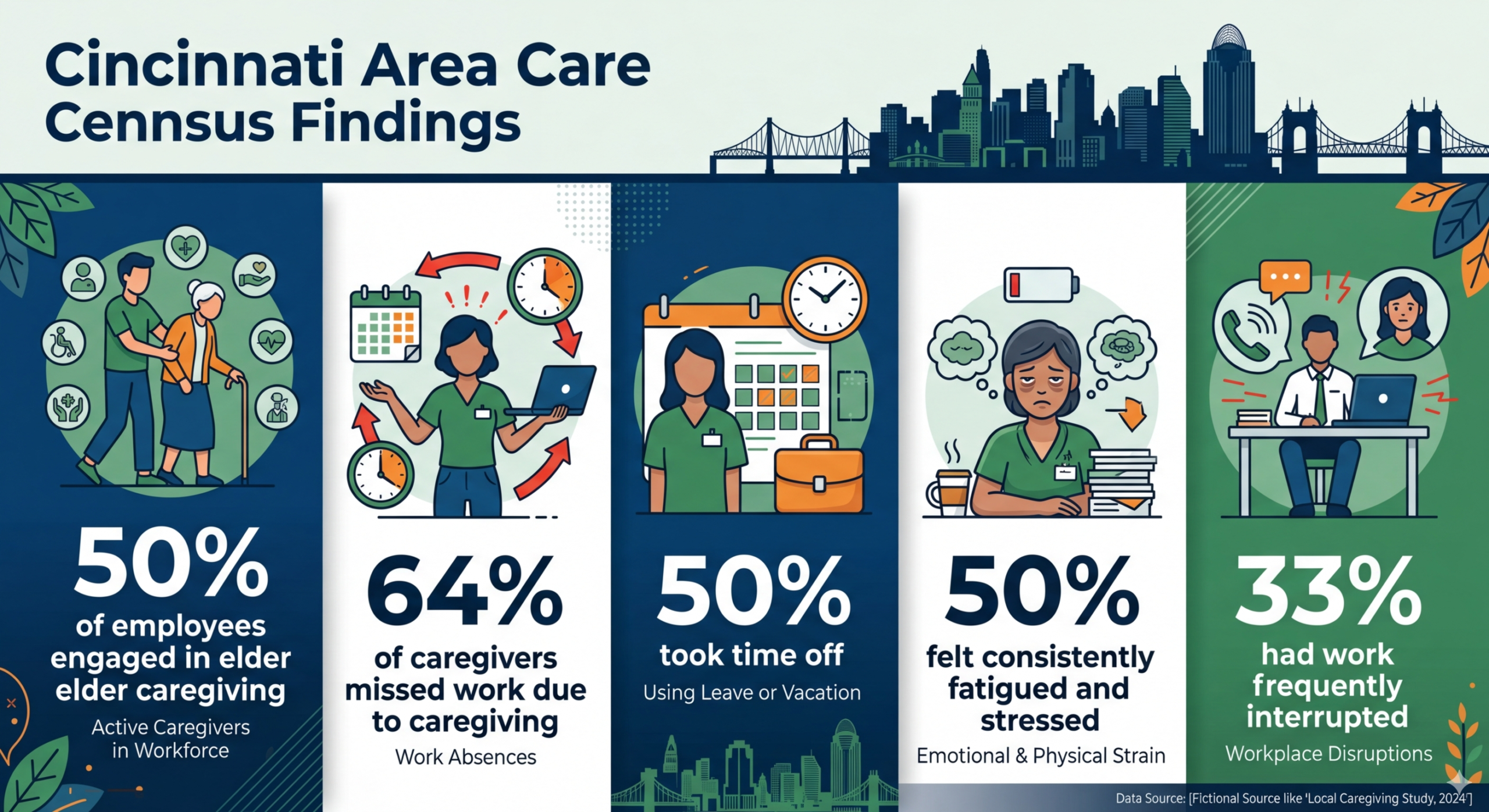
1.7 Million family caregivers in Ohio juggling work and unpaid care responsibilities
National/Ohio Impact Statistics
Work Accommodations
Nearly **70%** of working caregivers forced to:
- Reduce hours
- Take leave of absence
- Modify schedules
Financial Burden
- 77% of Ohio workforce (4.4 million workers) lack paid family leave
- $3,100 in lost income for typical Ohio worker taking 4 weeks unpaid leave
Business Costs
- $33.6 billion annual national cost of lost productivity from full-time working caregivers
Impact Metric | Data Point
---------------------------
Ohio family caregivers | 1.7 million
Employee caregivers (Cincinnati area) | 50%
Missing work due to caregiving | 64%
Making work accommodations | ~70%
National annual productivity loss | $33.6 billion
Lost wages (4 weeks unpaid, Ohio) | $3,100
Ohio workers without paid family leave | 77% (4.4M workers)
Systemic Hurdles: Mental Health Disparities in Ohio's Black Business Community
Higher Distress, Lower Access
Higher Mental Health Burden
- 10.7% of Black adults report frequent mental distress (14+ days/month)
- vs. 8.2% state average
- 10.2% report unmet mental health needs
- vs. 7.5% state average
Critical Access Barrier
- Black residents: 12.5% of Ohio population
- Black psychologists/psychiatrists: <5% of Ohio providers
- "Pipeline Problem": Insufficient culturally competent providers
An employer can offer generous mental health benefits, but they are functionally useless if Black employees cannot find providers within the network whom they trust and who understand their lived experience.
Ohio Mental Health Disparity | Black Ohioans | State Average
---------------------------
Frequent mental distress (14+ days) 10.7% | 8.2%
| Unmet mental health need (past 12 months) 10.2% | 7.5%
Population representation 12.5%
Psychologists/psychiatrists representation <5% |
Quantifying the Return: Investing in Mental Health Pays
Well-designed mental health programs generate measurable returns by reducing healthcare costs, boosting productivity, and improving retention.
ROI Statistics Showcase (Large, Visual Numbers):
Primary ROI Range (Hero Visual):
Every $1 invested returns $1.62 to $5+
Conservative Estimate
- $1.62 return per $1 invested
- Source: Deloitte research
- Based on established programs
Mental Illness Treatment
- $4.00 return per $1 spent
- Driven by health and productivity improvements
Integrated EAPs
- $5.39 return per $1 invested
- Modern, deeply integrated programs
⏰ ROI is a lagging indicator
- Median annual ROI: $1.62
- Programs 3+ years old: $2.18 ROI
- Early programs may not show positive ROI yet but are mitigating rising costs (disability claims, turnover)
- Patience and commitment are essential for success
A Practical Framework for Building Your Business Case
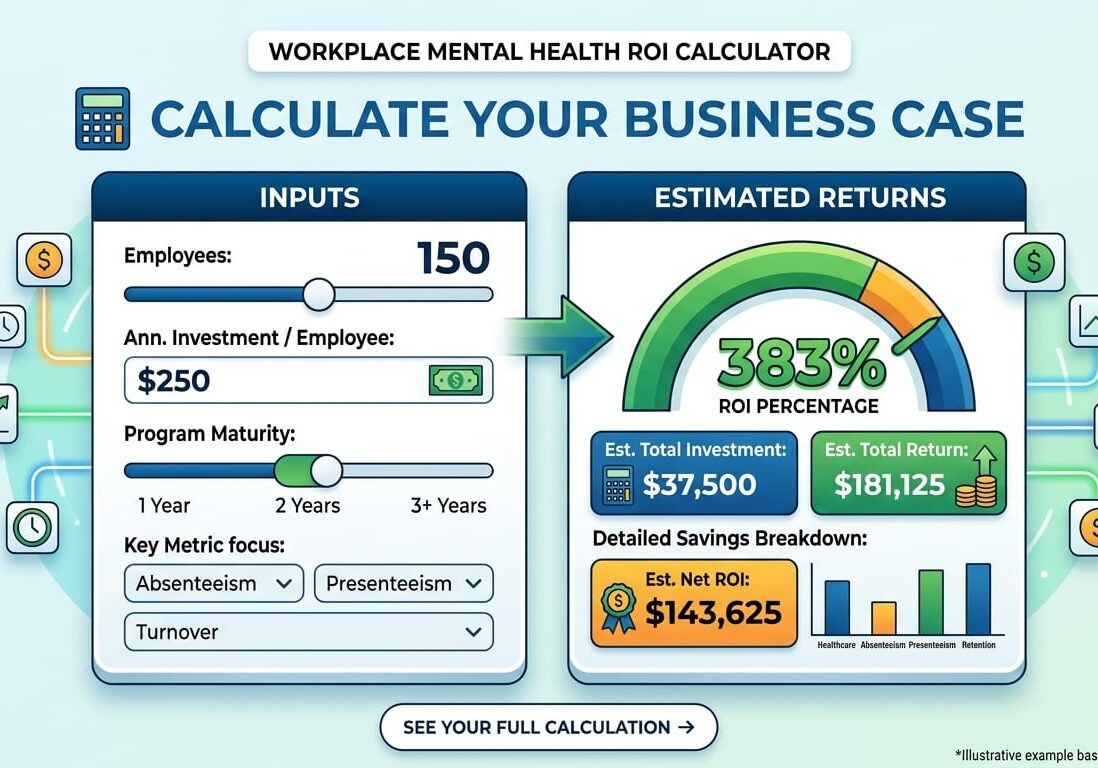
Interactive Calculator Preview
Lorem ipsum dolor sit amet, consectetur adipiscing elit. Sed mollis nulla ut ligula accumsan varius. Maecenas viverra vestibulum quam ac efficitur.
Suspendisse euismod purus vel ex porta pretium in a lorem. Vestibulum semper quam viverra, scelerisque sem eu, consequat elit. Maecenas viverra eros libero.
A Practical Framework for Building Your Business Case
Use leading indicators to show early progress while waiting for long-term financial impacts
LEADING INDICATORS (Program Health & Engagement)
Track these for early wins and leadership buy-in:
-  EAP utilization rates
- Mental health benefit usage
- Training participation rates
- Employee engagement survey scores
- Manager support questions
- Psychological safety questions